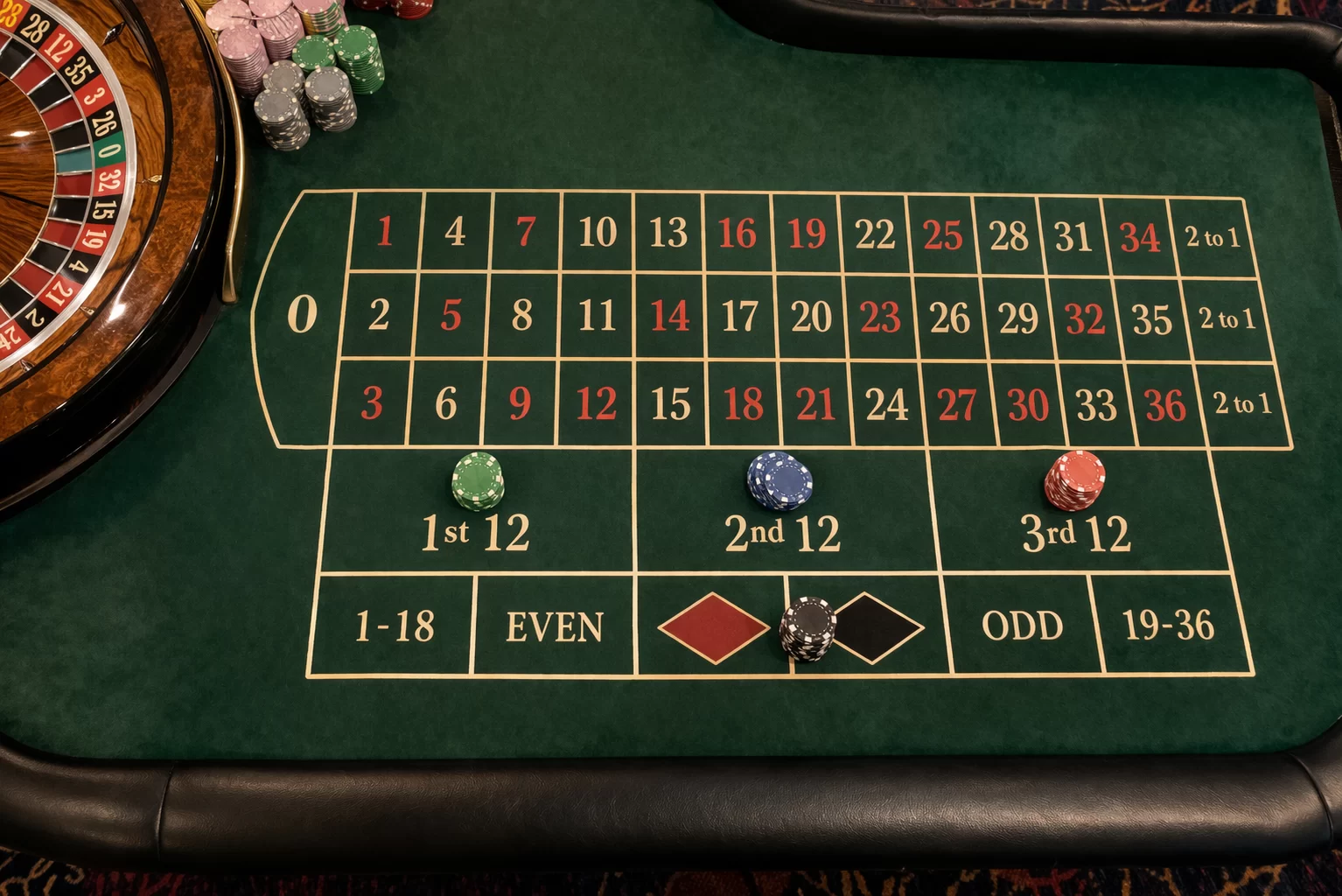
This 4-step roulette method has racked up 43,000 views in days on YouTube. It promises to turn $50 into $350. But what do the probabilities actually say when you run the full numbers?
The technique known as the “Parcours du Combattant” (Obstacle Course) has been circulating widely on social media in early 2026. Its premise is straightforward. Four consecutive steps, each building on the previous one, with a safety net at the final stage. A sevenfold return if you complete the full run.
On paper, it is appealing. In practice, the mathematics tell a different story.
How the technique works step by step
The starting point is a $50 bet. Each step reinvests part or all of the winnings from the previous step.
Step 1. $50 on red. Win probability: 48.6% on a European roulette wheel (single zero). If successful, your bankroll reaches $100.
Step 2. $50 on the first dozen, $50 on the third dozen. Win probability: 64.8%. If successful, your bankroll reaches $150.
Step 3. $75 on the first column, $75 on the third column. Win probability: 64.8%. If successful, your bankroll reaches $225.
Step 4. Retrieve your original $50 stake. Place the remaining $175 on odd. Win probability: 48.6%. If successful, your final bankroll reaches $350. If you lose, your original $50 is preserved.
The fourth-step safety net is the key selling point. You never walk away empty-handed if you reach this stage.
What cumulative probabilities actually reveal
Here is what the presentation does not break down in detail. To reach step 4, you must successfully complete the first three steps consecutively. Cumulative probability is calculated by multiplying individual probabilities.
Steps 1 through 3 completed: 48.6% × 64.8% × 64.8% = approximately 20.4%.
This means that out of 100 attempts, you will reach step 4 roughly 20 times. Of those 20 times, you will win the final step in 48.6% of cases. That translates to approximately 10 complete runs out of 100 attempts.
| Scenario | Probability | Net result |
|---|---|---|
| Fail step 1 | 51.4% | – $ 50 |
| Fail step 2 | 17.1% | – $ 100 |
| Fail step 3 | 11.1% | -$150 |
| Fail step 4 | 10.5% | $ 0 (stake recovered) |
| Full completion | 9.9% | + $ 300 |
The net result column tells the essential story. In 79.6% of attempts, you lose between $50 and $150 before even reaching the safety net. The single most likely outcome remains a loss at step 1, which occurs roughly one in every two tries.
The house edge never disappears
Every step in this technique relies on standard European roulette bets. Red/black, dozens, columns, odd/even. On each of these bets, the casino maintains a mathematical edge of 2.7% thanks to the single zero.
No combination of these bets eliminates that edge. The Obstacle Course technique does not alter fundamental probabilities. It rearranges them. The step-by-step presentation creates a narrative structure that feels like progress toward a goal. The human brain interprets this progression as increasing odds. The mathematics remain strictly identical.
Over 100 attempts at $50 each, the expected value of this strategy remains negative. The casino retains its edge on every dollar wagered, at every step, without exception.
The creator of this technique acknowledges this explicitly. In the long run, the casino always wins. Strategies serve to structure play, not to reverse probabilities.
What this technique actually does well
To be precise on this point. This method is not a scam. It does not claim to guarantee winnings. Its real value lies elsewhere.
It imposes a playing structure. A defined budget ($200 recommended to cover losses). Clear steps. A built-in stopping point. A safety net at the final stage. For a recreational player seeking entertainment on a small budget, this discipline is preferable to impulsive, unstructured play.
The problem arises when the technique is perceived as a system for winning rather than a framework for playing. The difference is fundamental.
A player who understands they have a 10% chance of completing the run and who treats their $50 as the price of entertainment is playing informed. A player who reinvests losses believing the next attempt will be the one enters a dangerous cycle.
Essential checks before trying any roulette strategy
Before applying this technique or any other roulette strategy, three essential verifications.
First, play exclusively on a European roulette wheel with a single zero. American roulette with a double zero pushes the house edge to 5.26%. A difference that doubles your expected losses over time.
Second, set a maximum session budget you are prepared to lose entirely. The $200 recommendation to cover multiple attempts is a reasonable minimum. Never exceed this budget.
Third, verify that your platform holds a valid regulatory license. For US players, state-licensed online casinos in New Jersey, Pennsylvania, Michigan and other regulated states guarantee fairness controls on random number generators. Outside the US, MGA, UKGC or Spelinspektionen licenses provide equivalent oversight.
No roulette strategy turns a house-edge game into a revenue source. Play for entertainment, with a budget you can afford to lose.
By analysts specializing in casino game probabilities. Sources: probability calculations on European roulette (37 numbers), EGBA house edge data 2026.